Latin America’s Failure to Distribute Its Wealth Fuels Leftward Turn
|
|
| Francisco González |
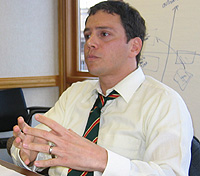
WASHINGTON, September 14, 2006 — Despite Latin America’s recent impressive economic growth, widespread poverty and skewed income distribution is fueling the rise of left-wing governments across the region, said Associate Professor Francisco González of SAIS’ Western Hemisphere Studies department. In a talk to the fall 2006 International Reporting Project Fellows, González explored the reasons for this leftward turn, which comes as regional economies are booming.
In the past three years, said González, Latin American economies have performed better than at any other time since the early 1970s. They have largely tamed inflation, which wreaked havoc for decades. But Latin America still has, in González’s words, one of “the most skewed distributions of wealth and income in the world.” In particular, he cited the example of Brazil, comparing its “obscene” distribution of wealth to that of the Democratic Republic of Congo in Africa. In the 1990s, Latin Americans hoped that newly democratic governments would deliver greater general prosperity with free market or “neo-liberal” economic policies. Unfortunately, says González, “fifteen years onward, what we see is very little progress.”
The rise of left wing governments across Latin America has been no accident, González said. Brazil, Chile, Argentina, Venezuela, Bolivia and Uruguay are already ruled by leftist governments. Many left-wing candidates in other countries have also scored big gains in elections within the last year. “They’ve been able to tap into this latent discontent, and to rally the masses behind them,” he said.
Many of these leaders have used the most traditional political tool of all – cash – to win allies, González said. Governments have “been able to put money where their words are,” González said, referring to the massive social spending that leftist governments have embarked on. “This is something [governments] had not been able to do in the 80s and the 90s,” as they struggled with runaway inflation and massive debts.
Although certain leaders such as Hugo Chávez in Venezuela and Luiz Inácio Lula da Silva in Brazil may rail against racial and business elites, González said they are not “acting as a Robin Hood”, seizing private assets from the rich to give to the poor. Instead, state coffers are swelling with revenues from surging commodity prices such as soya, iron ore and oil.
González highlighted the variety of ideologies within Latin America’s “leftward swing.” He distinguished between the urban authoritarian doctrines of figures such as Chávez, and the social democratic visions of leaders such as Michele Bachelet in Chile and Tabaré Vázquez in Uruguay. What was common across the region was that left wing parties had achieved prominence at a dizzying speed, even where they had not captured the presidency. In the most recent presidential contest, Andrés Manuel López Obrador of Mexico had pushed the PRI, which ruled Mexico for seven decades, into third place with a party (the PRD) that was less than two decades old.
González warned that the leftward push threatened Latin America’s fragile democratic institutions in some countries. He pointed in particular to the rise of militarism in Bolivia, and defeated presidential candidate López Obrador’s protests in Mexico City as attempts to sidestep the democratic process through shows of strength.
González cited the threat posed by politicians who use race as a rallying cry. He cautioned that the idea that “los blancos tienen que pagar” (“the whites have to pay”) is a dangerous one. “If you politically mobilize sections of the population, and your main way of doing this is by confronting them with another section of your own population, what you could end up with is political polarization and maybe even violence.” He joked that “from that perspective, I think that America bashing is healthier.”
Copyright © 2005 International Reporting Project. All Rights Reserved.