Survival rates higher among recently wounded troops in Iraq, Afghanistan
WASHINGTON, February 24, 2005 — Survivability rates for American troops have risen to an all-time high during the Iraq and Afghanistan wars, and doctors at Walter Reed Army Medical Center in Washington, DC, say that's partially due to advances in their medical technology.
|
|
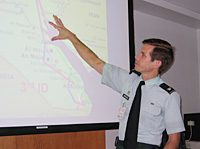
| Dr. Craig Shriver |
Dr. Craig Shriver, chief surgeon at Walter Reed, told Fellows from the International Reporting Project (IRP) here today that the improved survival rates are the result of a timely combination of advances in transportation, medicine, and battle gear technology.
Cutting edge medical care has been moved nearly to the front lines in Iraq, with doctors working in “combat support units,” or high-tech tents where they can do everything from bandage a small wound to perform brain surgery, Dr. Shriver said. Physicians stabilize the critically wounded, then immediately evacuate them to Landstuhl Hospital in Germany, and then on to Walter Reed if necessary. A critically wounded patient can be flown from Iraq to Walter Reed in less than three days, a transportation speed unimaginable in previous conflicts. “We cannot move Walter Reed to the battlefield,” noted Dr. Shriver, “so we must move the patients to Walter Reed.”
Troops wounded in explosions of shrapnel-laced Improvised Explosive Devices (IEDs) or hit by sniper fire are more protected than soldiers and Marines of yesteryear. Protective vests and helmets made of new generation fibers are shielding troops from some of the worst effects of blasts and gunfire and ensuring survival for some who would otherwise not live, Dr. Shriver told the journalists.
Two multiple amputees spoke candidly with the IRP Fellows, detailing their injuries and their paths to recovery. Army Specialist Kevin Pannell was hit during a patrol in northern Baghdad and lost both legs. Specialist Pannell arrived at Walter Reed last October, and has made a remarkable recovery, walking comfortably on his prosthetic legs just two months after receiving them. He plans to organize a team of amputees for an upcoming Eco-Challenge.
US Marine Corps Corporal Ryan Groves was hit by a mortar in Fallujah while getting out of his vehicle to visit his platoon. Cpl. Groves spoke about the medical and moral support at Walter Reed, including visits from the so-called “Milkshake Man,” a Vietnam veteran and double amputee, who brings milkshakes and cheer to the patients in Walter Reed's Military Amputee Research Program. Specialist Pannell and Corporal Groves are among the more than 225 amputees who have received treatment and physical therapy at Walter Reed. Dr. Shriver estimates that roughly 50 percent of multiple amputees from Iraq and Afghanistan who are alive today would have died in past conflicts.
Today's amputees are benefiting greatly from new prosthetics including the computer-controlled C-Leg, and there may be even more help for amputees just ahead. In a promising development, Walter Reed physicians are collaborating with researchers at Wake Forest University on tissue engineering, aiming to make it possible to grow new muscle and limbs from body tissue. “Experts feel we'll have extremities [made from regenerated tissue] in five years,” said Dr. Shriver.
Copyright © 2005 International Reporting Project. All Rights Reserved.