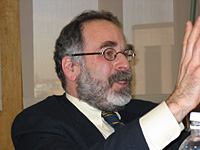
Marc Chernick
Rising Crime Poses New Challenges for Latin America, says Chernick
WASHINGTON, February 2, 2005 — The wars that brought massive American military presence – and many deaths – to Central America came to an end with the fall of the Soviet Union. But the handshakes and peace agreements that followed did not translate into peace for region, a scholar on Latin America told IRP Fellows at a seminar here today.
|
|
Marc Chernick
|
“Today, for the average [Latin American] citizen, it's less safe than it was during the war,” Marc Chernick of Johns Hopkins University's School of Advanced International Studies (SAIS) and Georgetown University said.
Chernick noted that an Inter-American Development Bank survey showed that between 1999 and 2003, Honduras, El Salvador, Colombia and Guatemala had the world's highest murder rate, trailing only South Africa.
“One of the things the peace accords did [in Latin America] was downsize and even eliminate security forces in some countries because there was no longer fighting,” Chernick said.
“What no one thought about was this notion of citizen security,” he added. “What do you do to protect citizens post-conflict? What do you do with all the unemployed soldiers? What do you do with the unemployed death squads?”
The failure to incorporate former combatants into society gave birth to what Chernick calls bandolerismo, or banditry, a culture of lawlessness that is to blame for the violence that is so common in many Latin American cities.
“The issue of violence in Latin America today is one of crime,” Chernick said. “The political violence, the revolutionary violence, that's basically past everywhere in the region,” he said, with the one exception being Colombia, where the government has been engaged in a war with leftist guerrillas and right-wing paramilitary groups since the mid-1980s.
But in spite of the political and social violence that continues to claim thousands of lives nationwide, Colombia's capital, Bogotá, has transformed itself into an island of relative tranquility in a land at war. In the past nine years, the number of murders dropped by 60 percent in the city, largely because of public administrators and programs committed to making public safety Bogotá's top priority, Chernick said.
The Bogotá model, Chernick said, could be the answer to the problem of violence not only in Latin America, but in other violent urban cities across the world.
“I think [the Bogotá model] is transferable,” he said. “There's this core of programs, which can be repeated [in other cities], and that is from the community policing to the civic education programs.” Chernick added, “The idea is not to have Bogotá just be an anomaly.”
Copyright © 2005 International Reporting Project. All Rights Reserved.