Indians debate whether caste system helps or hurts development
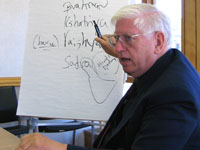
WASHINGTON, September 13, 2005 -- Despite increased mobility, decades of democratic governance, and economic development, India's caste system still plays a key role in the country, said Walter Andersen, the Associate Director of South Asia Studies at Johns Hopkins University School of Advanced International Studies (SAIS).
|
|
| Walter Andersen |
In a seminar with IRP fellows, Andersen said that the caste system, a Hindu-inspired social and religious class structure that came into existence around 1500 BC, still hampers development across India, despite extensive affirmative action programs for disadvantaged or "scheduled" castes successive Indian governments have put in place.
Andersen, a former State Department official who followed South Asia for the department's Bureau of Intelligence and Research, said that while caste group identification is not breaking down, the notion of caste hierarchy, that puts Brahmins at the top and Dalits or "untouchables" at the bottom, is beginning to change.
"There is upward mobility among the lower castes," Andersen said, with lower castes reinventing themselves as they move up the economic ladder. And in spite of the negative connotation typically associated with the term "caste," he says many Indian intellectuals argue that such social classifications can play a stabilizing role. "There are identity benefits and material benefits. Democracy appeals to numbers. And castes gives political weight to numbers," Andersen said.
India's recent boom, a byproduct of economic reforms launched in 1991, is also hastening social change, according to Andersen. The country's middle class has doubled in the past decade and India's growth rate has surged from 3.5 percent to 8 percent. As the middle class grows larger and more powerful, some believe the caste system will eventually be undermined.
With increased economic development and mobility, Andersen said, the definition of identity begins to broaden. "Typically castes would identify with a particular vocation. That has begun to break down as modernity offers other options," he said.
Andersen cited the growth in India's information technology sector as one example. New professions, such as the jobs supporting the outsourcing industry, are not bound historically to the caste hierarchy. "Any occupation that does not have an old boys' network linked to it is much more open," Andersen said. In fact, the outsourcing industry has a high percentage of lower caste people coming up through the ranks based on merit.
As mobility increases, Andersen warned, tensions flare between castes, which remain such a basic building block of Indian society that even some Muslims and Christians in India use the caste system. Many are calling into question the Indian government's extensive quota system, put in place over a half a century ago to increase the number of disadvantaged people in government jobs, academic institutions and political bodies.
"It is a debate between meritocracy and equity," Andersen said. He also noted that Dalits, historically the lowest ranking caste, are beginning to protest. "What you [are beginning to] see in India is inter-caste violence," he said. "That is good. It shows you they are fighting back."
Copyright © 2005 International Reporting Project. All Rights Reserved.