Layers of Identity Make African Unity Elusive, says Africa Scholar
WASHINGTON, September 20, 2005 — People in some African countries increasingly identify themselves by their religion, a trend partly spurred by Christian and Muslim groups that dominate development efforts in those countries, said Sulayman Nyang, professor of African Studies at Howard University.
|
|
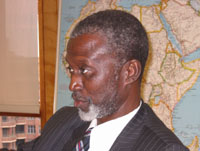
| Sulayman Nyang |
The trend toward religious identity is pulling some people away from ethnic and tribal identities. In some countries, such as Nigeria, the rise of Christian and Islamic fundamentalism could spur conflict or fracture the national identity, Dr. Nyang said. “People who were tribal, and were confined to a specific locality, now have these universal visions of Islamic or Christian solidarity,” said Dr. Nyang, an expert on African systems of thought and former president of the InterFaith Conference of Metropolitan Washington.
In a seminar with IRP fellows, Dr. Nyang said the layering of spiritual, tribal, ethnic and national identities has long flummoxed many African leaders trying to forge a national character. The continent is home to over 1,000 ethnic groups and at least 40 language groups.
In the 1950s, some African leaders such as Kwame Nkrumah of Ghana tried to rally society through Pan-Africanism. The strategy failed, Dr. Nyang said, because people were not ready to “identify with the continent.” The identity question also is connected to development, because it can either accelerate or impede it. Some leaders have tried to fuse the priorities of development with traditional African values.
For Julius Nyerere, the former president of Tanzania, this meant the concept of ujamaa , or “familyhood.” Nyerere appealed to Tanzanians to see the nation as a family. He wanted them to learn science and technology from the West but maintain communal values.
However, Nyerere's farm collectivization programs actually hurt the Tanzanian economy. His forced relocation of thousands of residents relocate from their villages to modern “super-villages” backfired because people did not want to leave their ancestral lands, Dr. Nyang said. When he retired, Nyerere acknowledged his failure. “Because he wanted to rearrange the mental furniture of those Tanzanians so quickly, he lost them,” Dr. Nyang said.
Today, many religious groups are involved in activity that was traditionally the domain of the state. Religious identity is gaining currency as groups appeal to followers by providing them with material resources. “They can give you a medical doctor when you are sick, and they can take you to the hospital for treatment,” Dr. Nyang said. “When you need pharmaceuticals, they can provide that.”
Copyright © 2005 International Reporting Project. All Rights Reserved.