Mutating AIDS Virus Complicates Search for Vaccine, Says Lead NIH Researcher
WASHINGTON, October 7, 2004 -- A vaccine is the “best hope” for controlling the AIDS epidemic, but many scientific, political and social hurdles lie in the path of its development, according to a leading researcher.
|
|
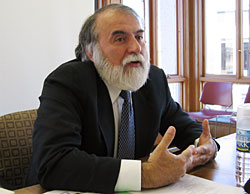
| Jorge Flores |
At a seminar for International Reporting Project fellows, Dr. Jorge Flores, Chief of the Vaccine Clinical Research Branch of the Division of AIDS at the National Institutes of Health noted that vaccines have produced remarkable public health improvements throughout history, such as the eradication of smallpox and the near-eradication of polio.
“A vaccine is easily the best instrument we have today to combat and prevent infectious diseases,” he said. “It is the best hope we have to control the [AIDS] epidemic, especially for this virus where many other ways of trying to prevent [it] have failed.”
Ideally, it would be cheap, safe and effective worldwide, and would confer long-term protection, Flores said.
The HIV Vaccine Trials Network is currently testing potential vaccines in 12 human studies, and several others will soon be launched. A large international trial to test a vaccine against the three most common strains of HIV could get underway in 2007.
But unlike the agents that cause smallpox, polio, measles and other infections, HIV has some unique traits that defy conventional vaccine development.
For example, the AIDS-causing virus infects the immune system's own CD4 cells, which play a critical role in maximizing the antibody and so-called killer T-cell responses to an invading agent. A retrovirus, HIV integrates its own genetic material into the DNA of the CD4 cell.
“Once the virus establishes itself in the organism, it never goes away,” Flores said. “There is no single case yet in humans where the virus infected someone and the person was able to get rid of it.”
Scientists hope to create a vaccine that would allow the immune system to make antibodies that target HIV immediately, before the virus can get inside the cells. The vaccine should also generate killer cells that can quickly destroy infected CD4 cells.
Many vaccines work by injecting into the body the killed-but-intact agent or a live-but-altered agent, neither of which can cause disease. The immune system can then quickly respond to later exposure because it recognizes the distinctive proteins and sugars that adorn both the real and vaccine agents.
But like a piece of broccoli, HIV's protein core is surrounded by multiple florets of sugar, Flores explained. That coating makes it very difficult for antibodies to get to the stalk of the virus. Also, the sugars mutate frequently, so HIV can evade immune system attack.
Nobody has yet made a vaccine that successfully induces the production of antibodies to prevent the virus from entering cells, Flores said. The virus changes from day to day even within an infected person.
Scientists won't use a live-but-altered version of HIV as a vaccine because of the risk that the virus will mutate and cause harm. Killing the virus would destroy the sugar coat and impair the production of an antibody response, which is considered essential for success, the scientist explained.
Instead, researchers are trying to create HIV vaccines that target fragments or subunits of the virus, and to ferry the pieces into the body with familiar vaccines that have track records of establishing immune responses.
Figuring out whether those strategies work creates another set of challenges, Flores said. Because there is no sufficient animal model for the infection, human studies are necessary to move the research process forward.
But it can be difficult to recruit volunteers, especially women and teenagers. People worry about getting sick from the vaccine, being stigmatized for being in an AIDS-related trial, or losing the chance to get a more effective vaccine later. Political and cultural issues must be examined when conducting international trials.
“Participating in a vaccine trial is not an easy decision,” said Flores, adding that he had pamphlets if anyone was interested in enrolling.
Because there is typically a long lag time between HIV infection and developing symptoms, researchers have difficulty measuring the success of their experimental vaccine.
And it's possible that a vaccine could be developed that cannot prevent infection, but does extend the time it takes to develop symptoms. In fact, a large trial of such a vaccine will begin in December, Flores said.
The FDA does not have experience with vaccines that prevent progression of a disease, creating the potential for challenging regulatory issues, he added.
Federal agencies are taking steps to better coordinate their vaccine research efforts, and global partnerships are being built, Flores said. About $100 million annually is spent on clinical trials, and a similar amount is spent on pre-clinical work.
Already, multiple trial sites are set up and ready to get to work. But, after 16 years of trying to make an HIV vaccine, there haven't been any significant victories, Flores said.
As he put it, “We've been dressed up with no party to go to for years.”